
Skip to content

A friendly society, run for its members · No ads · No outside shareholders

YourCare

Who carries it

When you care about the cost of care

What care costs, who ends up paying, and what a community can do about it. The question this publication started from, and the reason YourCare exists.

Read the cost of care
306 daysAverage time from applying for Support at Home to the first serviceDept of Health, Disability and Ageing, program data, 27 Oct 2026
106,977Older Australians approved for help at home and still waiting, 30 June 2026Dept of Health, Disability and Ageing, program data, 27 Oct 2026
3rd highestAustralia's out-of-pocket health costs, after the US and SwitzerlandCommonwealth Fund, 2023
Every figure we follow, and where it comes from →
Five Giants · Essay 3 of 5 · 9 November 2026

Why the welfare state is straining everywhere at once

From Tokyo to Washington, welfare systems built for a younger world face the same three pressures: more old age, a care risk nobody pooled, and a quiet shift of risk onto households. The third Five Giants essay asks why the strain looks the same in such different places.

By Simon Schwab · Read the piece
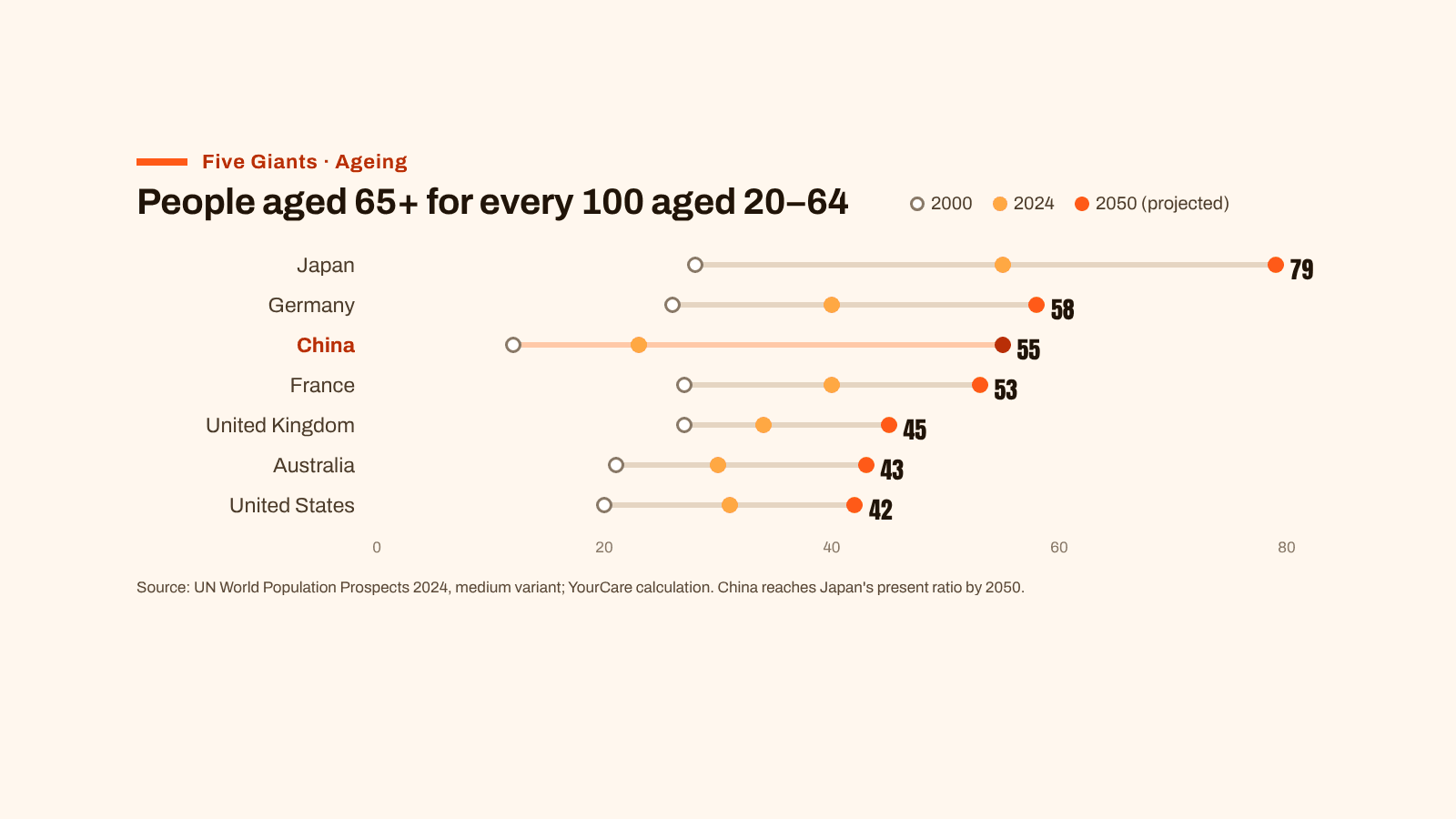
Chart: people aged 65 and over for every 100 aged 20 to 64 in 2000, 2024 and 2050 for Japan, Germany, China, France, the UK, Australia and the US

Read in order

Two series carry the argument. Each part stands alone; together they make the case.

Five Giants · Mondays

The spine series: who holds the risk, and what happened to the mutual tier

  1. 1Who holds the risk? Six ways the state came to carry it, and the tier it left behind4 Oct
  2. 2Before the state: how people insured each other, and why it stopped2 Nov
  3. 3Why the welfare state is straining everywhere at once9 Nov
  4. 4What is being triedComing
  5. 5The case for the third tier23 Nov
Money follows the person · Wednesdays

Who decides how the money for care is spent: the person, a provider, or the state

  1. 1Who decides? How money for care reaches people in six countries11 Nov
  2. 2Who sets the budget?18 Nov
  3. 3Cash or care?Coming
  4. 4The market that has to formComing
  5. 5Accounts or entitlements?Coming
  6. 6Holding it togetherComing

Five desks, one lens

Everything we publish →
AU · Home deskAustraliaNDIS, Medicare and out-of-pocket costs, aged care, JobSeeker, housing
UKUnited KingdomUniversal Credit's health element, PIP, social care, the mutuals pledge
USUnited StatesMedicaid rules, SNAP, the subsidy cliff, and charity versus mutuality
EUEuropeFrance's mutuelles, Germany's funds, the Dutch bread funds
CNChina and comparatorsXiang Hu Bao, the rural pension gap, Japan's kyosai, Singapore's CPF
Friendly society

What a community can do, now

Private group chat with mutual aid built in. The same three pages a new member sees when they open the app. How it works →

Communities used to take care of each other

For two hundred years, friendly societies did exactly this, with a ledger anyone could read. They can again.

Ask together. Give together.

Raise a pool when someone needs help. Pledges settle straight to them; we never hold the money.

Private by design

Messages are end-to-end encrypted in the app. We route them; we can't read them.

Join the waitlist

YourCare is preparing for App Store submission. Leave your name and we’ll tell you when it opens.

A friendly society for a world of rising costs

Before the welfare state, friendly societies were how ordinary people got by. We write about why that tier went, and we are building the tools to bring it back, run for its members.

The friendly society →