
Before the state: how people insured each other, and why it stopped
In 1887 George Church, a carpenter in Auckland, fell ill with locomotor ataxia, a disease of the spinal cord that slowly takes away the ability to walk. New Zealand had no state sickness benefit, and would not have one for another half-century. What Church had was his lodge, the Loyal Fountain of Friendship of the Manchester Unity Oddfellows. Its rules paid a sick member a pound a week for the first year and ten shillings a week for as long as the sickness lasted, and for eleven years the lodge paid. Then, in June 1898, the members decided that an earlier resolution letting him do some light work had been against the rules, and stopped his money. Church appealed to the district, and then to the order's board of directors in England. Both sided with the lodge. In 1900 he sued three of its trustees, by name, for £46 in arrears. The magistrate ruled that the court had no say over the lodge's decision, and that Church had persistently ignored its rule on medical certificates.
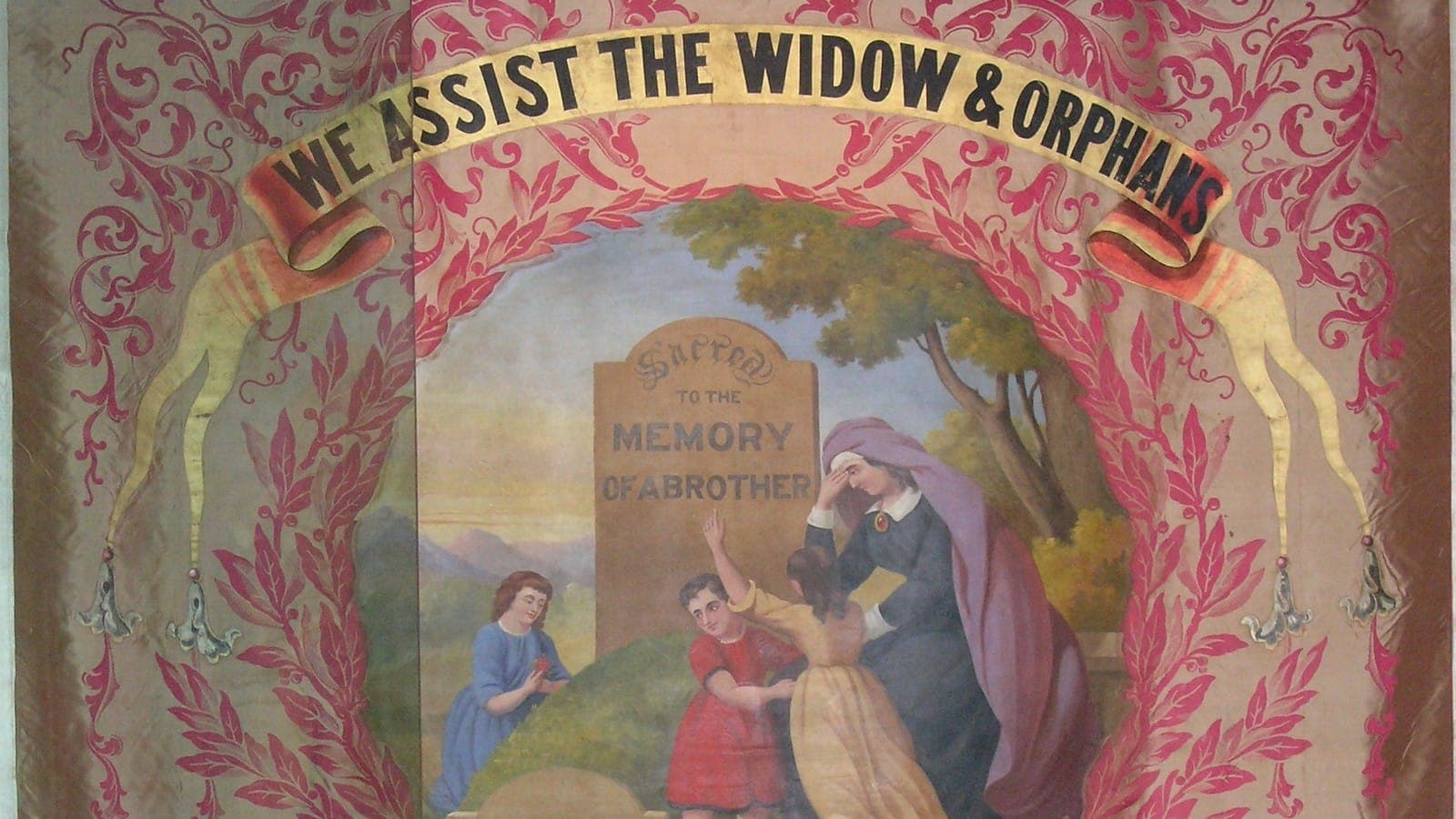
It is not a happy story, and it is not meant to be one. It shows almost everything the mutual societies were. The promise was written in the rules and kept for more than a decade without a penny from the state. The decision on one man's claim was taken by the men who paid for it. His appeal went up through the members' own institutions, not to a ministry. And in the end the pool protected itself against the member. The first essay in this series argued that every welfare state began as a takeover of something that already existed. This one is about the thing that existed, seen from the inside. It is easy to romanticise and easy to dismiss, and both mistakes lose the point. These societies were small, exclusive, often insolvent and frequently moralising. They were also, for tens of millions of people across three continents, the only insurance against sickness, death and old age they would ever have. And they ran on a design that most modern welfare systems have forgotten how to build: the people who paid in could see what came out, and decided together what the pool was for. That matters again now, as governments from Canberra to Paris push the cost of care back onto households.
Britain: the box, the steward and the visitor
The British friendly society began as a box. A dozen men in a trade or a street met monthly in the back room of a public house, paid a few pence into a locked chest with three keys held by three members, and drew a weekly sum when sickness stopped their wages and a lump sum to bury them when they died. By the 1870s a typical Manchester Unity lodge, such as the Invincible at Baslow in Derbyshire, charged a little over a shilling a month and paid ten shillings a week for six months of sickness, five shillings after that, £10 to bury a member and £5 to bury his wife. The scale of the movement was set out in the first essay; what matters here is how a lodge ran.
What made them work was not the money but the governance. Benefits were defined in the rules and paid by right, not discretion. A claim was checked by people who knew the claimant. At Baslow a sick member could not be out of the house after eight on a summer evening or six in winter, or go more than three miles without leave, and the sick visitors reported on every claimant at each lodge night. In July 1897 a Foresters court in Staffordshire heard that Thomas Forrester, on the box, had been seen weeding his front garden. He said he had only propped up a flower the wind had knocked down. The court fined him ten shillings and stopped his pay; he appealed, put down the five-shilling deposit, and lost it when the members' arbitration committee upheld the decision unanimously. Accounts were read at the lodge meeting, and the officers were elected and could be removed. The lodge was also a social institution, with regalia, parades, feasts and a funeral the whole lodge attended, and it is easy now to forget that this was part of the design: people pay into a pool they belong to, and they do not cheat neighbours they will eat with next month.
The weaknesses were as real. Most clubs priced their contributions by guesswork, and many collapsed when the young men who founded them grew old together and claims outran income; the affiliated orders spent the late nineteenth century learning actuarial science the hard way. Women, the chronically ill and the very poor were largely shut out, because a pool that admits the people most likely to claim cannot survive on small contributions. And the doctor the lodge hired on contract came to resent being employed by his patients. By the time Lloyd George used the societies to deliver national insurance in 1911, one observer could call his Act "the death warrant of the friendly societies", and the nationalisation of 1948 finished what 1911 began.
Germany: the state franchised the funds
Germany had its own funds long before Bismarck: guild boxes, miners' Knappschaften dating to the middle ages, factory funds and free relief societies. The 1883 sickness insurance law, described in the first essay, did not replace them. It made membership of one of them compulsory for industrial workers and left them to run themselves. Contributions were split two-thirds from workers and one-third from employers, and the boards were elected in the same proportion, workers and employers voting separately. By 1903 there were 23,271 funds insuring 10.2 million workers.
The German answer to the British weaknesses was compulsion plus self-government. Compulsion solved the adverse-selection problem that had starved the voluntary clubs, because the healthy could no longer stay out; self-government kept the member inside the institution. The number of funds has since fallen through mergers, from 1,815 in 1970 to 96 in 2023, but the contribution is still on the payslip and the boards are still elected.
France: the state tutored the societies, then sidelined them
France's sociétés de secours mutuels grew from about 180 in 1814 to some 2,500 with roughly a quarter of a million members by 1852, when Napoleon III's decree of 26 March offered a bargain. A society that accepted approval got tax exemption, communal help and legal standing; in return it accepted a ceiling of 500 members, confinement to its commune, and in the authorised category a president named by the state. The emperor made himself honorary president of several. It was tutelage, and the societies grew under it anyway, to more than 6,000 by 1870. The Charte de la mutualité of 1 April 1898 replaced political supervision with technical supervision, lifted the limits on size and territory, and let societies federate and add pensions and pharmacies. Membership reached about two million by 1898, 4.5 million by 1914 and some eight million by 1939.
The ordinances of October 1945 created the Sécurité sociale and abrogated the 1898 charter. Affiliation became compulsory and the insured were grouped into primary funds; the societies were renamed sociétés mutualistes and confined to the complementary layer, the part of the bill the state scheme does not pay. That is still their role: large, member-owned, with annual meetings, and with no say over the base scheme they top up.
Denmark: recognised, subsidised, then abolished
Denmark's sygekasser show the cleanest version of the cycle. The law of 12 April 1892 offered public recognition and a state subsidy, capped at two kroner a member, to any local or trade sick fund with at least fifty members (thirty in small rural communes) that admitted low-income workers, smallholders and artisans from the age of fifteen, provided free doctor and hospital care for members and their children, paid sick pay of up to two-thirds of earnings, and kept its surplus in the fund. Each fund had a general meeting and an elected board; the state supervised through an inspector. Membership was voluntary, and it grew from about 20 per cent of the population in 1900 to 42 per cent by 1925. A 1933 reform made membership a condition of the old-age pension; a 1960 amendment opened the funds to everyone and reduced them to one per municipality with council representatives on the board. By 1973 the funds covered 90 per cent of Danes, and that year a law passed in 1971 abolished them and financed health care from taxation. The member-run fund that had reached almost everyone was replaced by the municipality.
Australia and the United States: beaten by the doctors and the employers
Australia's lodges were, per head, among the strongest in the world. In 1879 an observer estimated that 80 to 90 per cent of manual workers belonged to a friendly society; in 1909 there were about half a million known members in a population of 4.8 million, and in mining towns nearly every man. Lodge medicine, a doctor on an annual contract to the society, was how most working families saw a doctor. The medical profession fought those contracts for three decades and won fee-for-service from the last national holdout, the Victorian Manchester Unity, in 1921. The state then took the ground in stages: pharmaceutical benefits in the 1940s, hospital and medical benefits through subsidised funds in 1953, and Medibank and Medicare in 1975 and 1984.
The United States had the same tier on the same scale. The historian David Beito estimates, conservatively, that one in three adult American men belonged to a fraternal lodge in the early twentieth century; total membership was about six million across 300 orders in 1899 and nearly 10.6 million by 1907. Black Americans, shut out of most white orders and most white insurers, built their own: Prince Hall lodges, the Grand United Order of Odd Fellows, the Knights and Daughters of Tabor, whose hospital in Mound Bayou, Mississippi, opened in 1941, and the Independent Order of St. Luke, which under Maggie Walker founded a bank in 1903. By 1931 nine Black fraternal hospitals were operating in the South. American lodges screened applicants, monitored claimants closely and excluded people whose incapacity was blamed on drink or "immoral conduct"; disabled people were largely kept out. What ended them was not a national scheme but a combination: the medical profession's campaign against lodge practice from the 1910s, which denied licences and hospital privileges to lodge doctors; state mothers' pensions and workers' compensation, almost unknown in 1910 and nearly universal by 1931; Social Security in 1935, after which one large order closed its orphanage for "lack of demand"; and the wartime tax ruling that made employer-paid insurance untaxed income, which turned the job into the membership. By the 1940s, Beito writes, conviviality and life insurance had replaced mutual aid as the lodges' business.
China and Japan: the village fund and the rotating pool
In Asia the mutual tier took different forms. Japan's tanomoshi-kō and mujin, rotating savings and credit associations in which each member contributes to a pot that each member takes in turn, are documented from the medieval period and survived well into the twentieth century; the agricultural co-operatives' kyosai mutual insurance, built after 1945, still covers millions of rural households alongside the state scheme. China's rural cooperative medical schemes of the 1950s and 1960s were the most extensive village-level health pools anywhere: financed by the collective and small member contributions, staffed by barefoot doctors on retainer, and covering about nine villages in ten by the mid-1970s. They were also the most fragile, because the pool belonged to the commune rather than to the members, and when the communes were dissolved in the early 1980s the funds dissolved with them.
What the six histories share
Read side by side, the mutual tiers worked for the same reasons and failed for the same reasons.
They worked because the pool was small enough for members to know each other, the benefit was written down before anyone claimed, the claim was checked by a neighbour rather than an official, and the book was read aloud. That combination kept fraud low without bureaucracy and kept contributions honest without a regulator. It is the open ledger, run on trust and a meeting hall.
They failed in four ways. First, the actuarial arithmetic: small voluntary pools aged with their members, admitted only the healthy, and ran out of money. Second, exclusion: the people most in need of cover, the chronically ill, many women, the poorest, were the people the pool could least afford to admit. Third, capture by professionals: in Britain, Australia and the United States the doctors who worked for the lodges organised to stop working for their patients. Fourth, the state and the employer, each of which offered something the lodge could not: compulsion and scale in one case, tax advantage in the other.
Notice what is not on that list. The mutual tier did not fail because members cheated each other, or because people preferred a ministry to a meeting. Where the state built on the tier, as in Germany, it fixed the first two weaknesses with compulsion and subsidy and kept the third and fourth at bay by leaving the member in charge. Where it replaced the tier, as in Britain, Denmark and Australia, it fixed the same weaknesses and lost the member. The next essay asks why the systems built in their place are straining everywhere at once.
Sources: Auckland Star, 12, 13 and 20 July 1900, and Evening Post, 17 July 1900 (Church v. trustees of the Loyal Fountain of Friendship Lodge, Papers Past); Amended rules of the Invincible Lodge, Manchester Unity, Baslow (Bakewell, c.1873); Audley Family History Society, "The Ancient Order of Foresters in Audley" (Court Lord Crewe minutes, July 1897); Historical Association, "The world in 1913: friendly societies"; History Cooperative, "Getting a grip: the roles of friendly societies in Australia and Britain reappraised"; Gesetz betreffend die Krankenversicherung der Arbeiter, 15 Jun 1883 (FES, gewerkschaftsgeschichte.de); Encyclopaedia Britannica (1911), "Germany" (1903 fund statistics); statutory health insurance fund counts 1970–2023 (GKV-Spitzenverband via Wikipedia, "Healthcare in Germany"); Musée de la Mutualité, "La société de secours mutuels"; Mutualistes (CIEM), "Histoire du mutualisme"; Carenews, "1850 : l'essor des mutuelles"; Chadelat, Regards no. 49 (En3s, 2016); Force Ouvrière 53, "Des origines des secours mutuels à l'instauration de la Sécurité sociale"; Lov af 12. April 1892 om anerkendte Sygekasser (danmarkshistorien.lex.dk); Danish Wikipedia, "Sygekasse"; WHO European Observatory, Denmark health system review (historical background); Beito, From Mutual Aid to the Welfare State (2000) and Heritage Foundation lecture (2000); VCU Social Welfare History Project, "Reciprocal aid: fraternalism and early social welfare history" (2024); histories of China's cooperative medical schemes; YourCare, "Who holds the risk?" (Five Giants essay 1).
Get Early Access
YourCare is preparing for iOS App Store submission. Join the waitlist.
Join the Waitlist