
The forecast is the policy
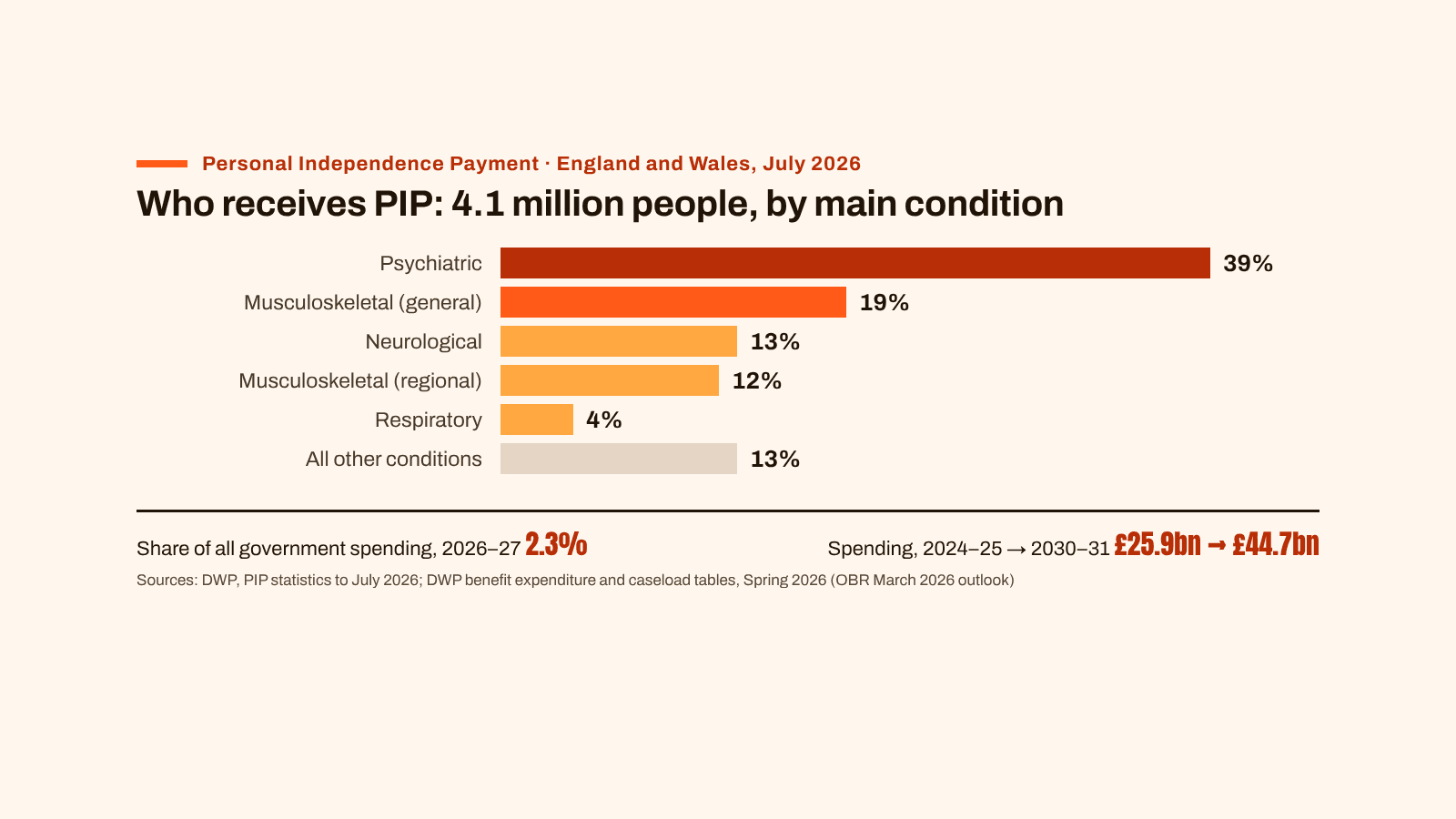
On Wednesday 28 October John Healey delivers his first Budget as Chancellor, and the Office for Budget Responsibility publishes the forecast it will be judged against. The government will spend about £1.42 trillion this year. A quarter of it, £353 billion, is welfare, and the largest single item is the state pension, at £154 billion. Personal Independence Payment, at £32 billion, is barely 2 per cent of the whole. Yet it is the line most of the pre-Budget argument has been about, for one reason: it is growing faster than almost anything else the state pays for. The Department for Work and Pensions' spring tables, built on the OBR's March outlook, put PIP at £25.9 billion in 2024–25 and £44.7 billion in 2030–31, a rise of almost three-quarters in six years. The forecast number of people entitled to it, averaged over each year, goes from 3.6 million in 2024–25 to 5.4 million in 2030–31.
PIP is not an out-of-work benefit, which is the first thing most people get wrong about it. It is paid to people between 16 and state-pension age with a condition expected to last at least a year, in work or out of it, regardless of income or savings, and it is meant to meet the extra costs of being disabled: the taxi instead of the bus, the heating left on, help with washing and dressing. It has two parts, for daily living and for getting about, and at this year's rates an award is worth between about £1,600 and £10,100 a year.
Who receives it has changed. By July this year the count had already reached 4.1 million people in England and Wales, 83 per cent of them of working age. For 39 per cent the main condition is psychiatric, more than any other group; musculoskeletal conditions come next. The OBR found that mental-health conditions rose from 28 per cent of new claims in 2019–20 to 38 per cent in 2023–24, and the department's own evidence to the Timms Review notes that more than half of claimants aged 16 to 19 have autism or ADHD as their main condition. The rise is mostly more people claiming, not easier decisions: approval rates fell over the same period. New awards have come down from their post-pandemic peak, by 37 per cent according to the Institute for Fiscal Studies, but remain 38 per cent above where they were before it. Why is not settled. The department lists the pandemic, wider recognition of mental-health and neurodevelopmental conditions, the cost of living and too few reassessments, and says how much each matters "has not been established".
That uncertainty is what Wednesday is about. The forecast is not a bill the state has received; it is an estimate of how many people will meet a test the state wrote, multiplied by a rate the state set. A British Budget runs on a welfare cap: a ceiling on the benefits whose spending the Treasury considers controllable, policed by the OBR at each forecast, with most working-age benefits, disability benefits among them, inside it and the state pension outside. When the projected caseload rises, the question a Treasury asks is not who is disabled but which parameter bends the line.
There are only three. The rate: what a successful claim pays. The gate: who passes the test. The review: how often a person must pass it again. Each has been moved or is about to be. The rate moved last year. Under the Universal Credit Act 2025 the health element for a new claim from April 2026 is £217.26 a month, against £432.27 for someone already receiving it, and it is frozen until 2029–30. The gate is what the Timms Review of PIP exists to redraw: its interim report on 9 July, drawn from more than 38,000 responses, found the benefit "no longer fit for purpose"; its September update sketched a PIP that pays by "cost category" and part-pays in services, and the final report is due this autumn. The review is the reassessment. The Prime Minister's first speech, on 20 July, promised "a fair and sustainable way to bring the welfare bill down".
Read as a mechanism rather than a programme, the three parameters have one property in common. A lower rate does not lower the cost of being disabled; it moves the difference to the household. A narrower gate moves the whole cost to the household, plus the cost of proving. A more frequent review moves the cost of proving onto everyone, including those whose award will not change. The forecast is a forecast of need. The Budget treats it as a forecast of spending. The gap between the two is what a kitchen table absorbs, and it does not appear in any table the OBR publishes.
What Wednesday decides is the size of the gap, not its existence. Whatever the Chancellor announces on disability, the line will be bent by rate, gate or review, and each bends it by moving cost downward. Three things in Wednesday's documents will show which lever he has chosen: whether the welfare cap is reset or breached, whether the OBR's count of people entitled to PIP in 2030–31 moves from 5.4 million, and whether the Timms Review's "cost categories" appear as a costed measure before its final report. The question for a country with 5.4 million people on one benefit by 2031 is not how to make the number smaller but who ends up carrying what the number stands for.
Sources: Department for Work and Pensions, Benefit expenditure and caseload tables 2026 (Spring Forecast, 14 April 2026, consistent with the OBR Economic and fiscal outlook March 2026); House of Commons Library, Autumn Budget 2026: background briefing (22 October 2026); House of Lords Library, UK fiscal outlook (18 September 2026); Universal Credit Act 2025; Timms Review of PIP, interim report (9 July 2026, via ITV News) and co-chair update (9 September 2026); Prime Minister's statement, 20 July 2026 (via the House of Lords Library).
Get Early Access
YourCare is preparing for iOS App Store submission. Join the waitlist.
Join the Waitlist