
When money for care follows the person, someone has to decide how much money. The previous piece in this series looked at who decides how a budget is spent. This one looks at the step before: who, or what, sets its size. In most systems the answer is now a scored assessment, and in several it is an algorithm whose result no person can change. In October that question reached Australia's Commonwealth Ombudsman.
Australia: a tool that cannot be overridden
Older Australians who need help at home are assessed with the Integrated Assessment Tool. An assessor gathers information; the tool turns it into one of eight Support at Home classifications, with budgets from about $10,700 to $78,100 a year as of November 2025. The Ombudsman's report, published on 26 October, found that under the law the tool's decisions "cannot be overridden and changed, even if they are clinically inappropriate", and that until the new Aged Care Act took effect the department had told providers and the public that they could be. According to The Weekly Source, only 0.6% of assessments made between December 2024 and March 2026 were audited or reviewed. The Ombudsman found the arrangements at odds with the Robodebt royal commission's recommendations on transparency in automated decisions, and made ten recommendations, the first of them a change to the law to let assessors override the tool.
The government had already announced, on 15 October, an independent review of the tool, to be tabled in Parliament in the first half of 2027, and an escalation pathway from January 2027 under which senior officials can review a classification in exceptional cases. The department accepted most of the Ombudsman's recommendations but not, in full, the two on override.
The disability scheme is heading the same way. Under amendments passed in 2024, NDIS participants will have a needs assessment, using a tool called I-CAN, and a budget calculated from it by a method set in rules. The rollout, once due in mid-2026, has been put back to April 2027. An earlier attempt, "independent assessments", was abandoned in 2021 after opposition from participants.
Germany and Japan: points, then people
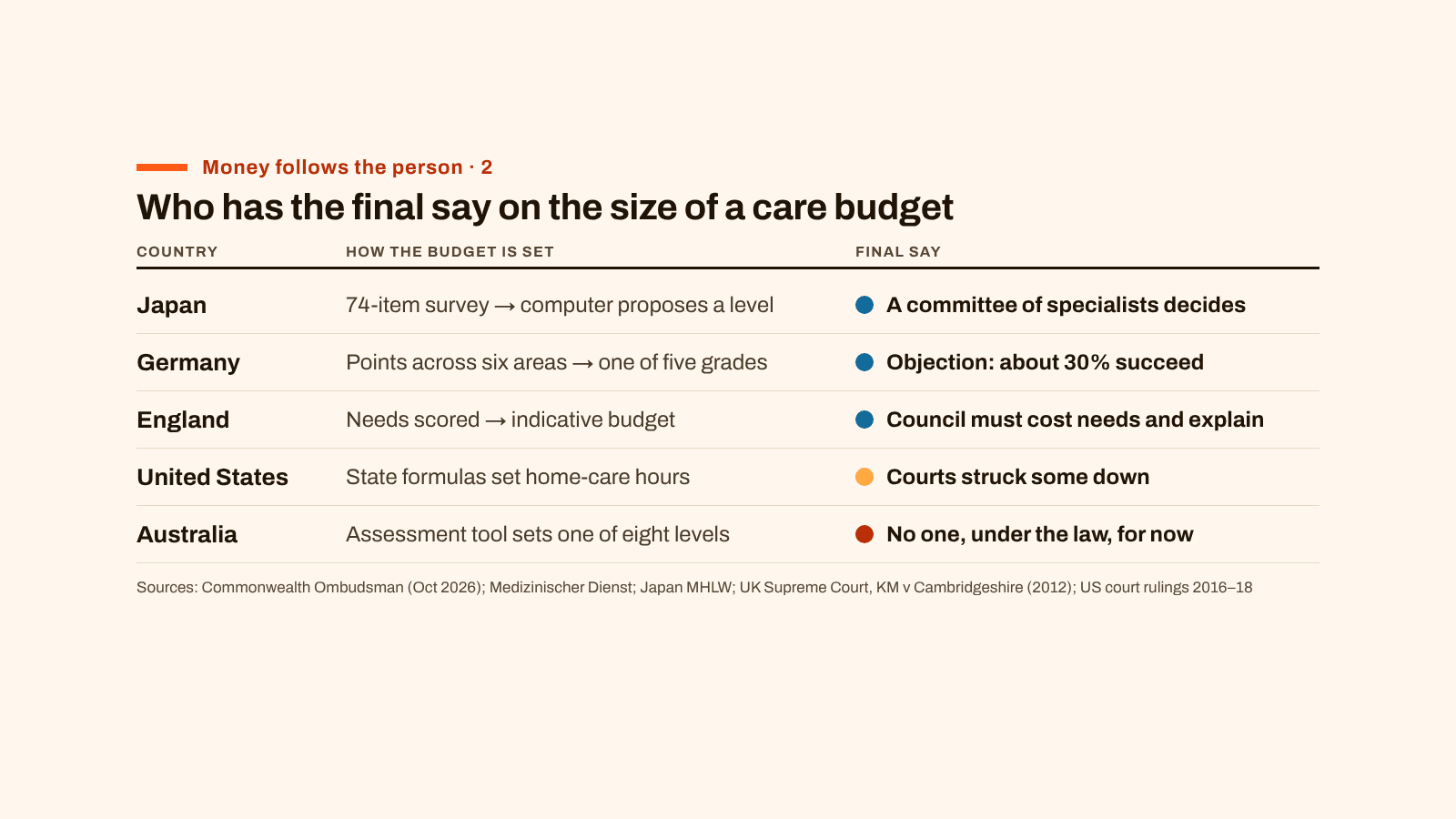
Germany sets care budgets by points. A nurse or doctor from the Medizinischer Dienst scores a person across six areas of life, weighted most heavily on self-care, and the total places them in one of five care grades. The grade fixes the benefit: in 2025, grade 3 paid €599 a month in cash or €1,497 in services; grade 5, €990 or €2,299. People can object, and many do so successfully: according to the health ministry, about 30% of objections succeeded each year from 2020 to 2022.
Japan uses a computer and a committee. A 74-item survey of the person produces a first, computerised judgement of their level of need, one of seven. A board of health, medical and welfare specialists then makes the second and final judgement, using that result alongside the assessor's notes from the home visit and a doctor's opinion. The algorithm proposes; people decide.
England and the United States: formulas in court
English councils use a resource allocation system: needs are scored and the score converted by formula into an indicative budget. In 2012 the Supreme Court held that using such a formula was "entirely rational", provided the council then costs the person's actual needs and can explain how it reached the figure. The statutory guidance repeats that a formula is a starting point, not a cap.
American courts have been less forgiving. In 2016 Arkansas brought in an algorithm to set hours of Medicaid home care; it cut care for many people who used it, and in May 2018 a state judge ordered it stopped because it had not been properly adopted as a rule. In Idaho a federal judge ruled in 2016 that the state's budget formulas, which it had kept secret, violated due process, and ordered them disclosed and tested. In May 2026 a lawsuit in Nebraska challenged a new assessment system over unexplained cuts of around a third. Most American states now use standardised assessment tools to set home-care hours.
What the systems share
Every system that hands people a budget has to size it, and every one now does so with a scored assessment. They differ in three things. The first is whether a person can change the result: in Japan a committee always can, in Germany an objection often does, in England the formula is only a starting point, and in Australia, for now, no one can. The second is whether the rules are public: courts in England and the United States have insisted that people be able to see how their figure was reached. The third is whether anyone checks: a small share of decisions audited leaves errors to be found by the people they fall on.
The design choices are not exotic. Australia's Robodebt royal commission set them out in 2023: a clear legal basis, a path to review, plain explanations, rules open to scrutiny and a body to audit the system. The next piece in this series asks what people do with a budget once it is set: take the cash or the care.
Sources: Department of Health, Disability and Ageing, Support at Home classifications and budgets (Nov 2025); Commonwealth Ombudsman, Automation and oversight in aged care (Oct 2026), via SBS News and The Weekly Source; The Weekly Source, 15 and 26 Oct 2026; National Seniors, 30 Oct 2026; Department of Health, NDIS Act changes; NDIA updates on new framework planning (2025–26); MS Australia (Jul 2021); Medizinischer Dienst, assessment leaflet (Jan 2025); Kreis Coesfeld, care insurance benefits from July 2025; Deutsches Ärzteblatt, 18 Dec 2023; Yamada and Arai, Annals of Geriatric Medicine and Research (2020); Tokyo Metropolitan Government care insurance guide; R (KM) v Cambridgeshire County Council [2012] UKSC 23; Washington Times, 15 May 2018; ACLU, K.W. v. Armstrong (Mar 2016); National Health Law Program, 8 May 2026; Upturn, Calculated Need (Oct 2025); Parliamentary Library on the Robodebt royal commission (Jul 2023).