
Why the welfare state is straining everywhere at once
This autumn the same story has turned up on five desks at once. In Germany a nursing-home resident's own share of the bill reached €3,364 a month in July, up €256 in a year. In Australia the government has confirmed that 6,436 people died in 2025–26 after being approved for care at home and before the money arrived. In Britain the promised free personal care will stop at 65. In America federal Medicaid cuts of about $990 billion over ten years are on the way. In China the retirement age is rising for the first time since the 1950s. These are five countries with five different welfare systems, built on different founding ideas. Yet they are all doing the same thing at the same time.
The first two essays in this series explained how the state came to carry risk, and what it did with the mutual tier that carried it first. This one asks why the structures built in the twentieth century are straining in the twenty-first, and why the strain looks so similar everywhere. There are three reasons, and they compound.
More old age than the systems were built for
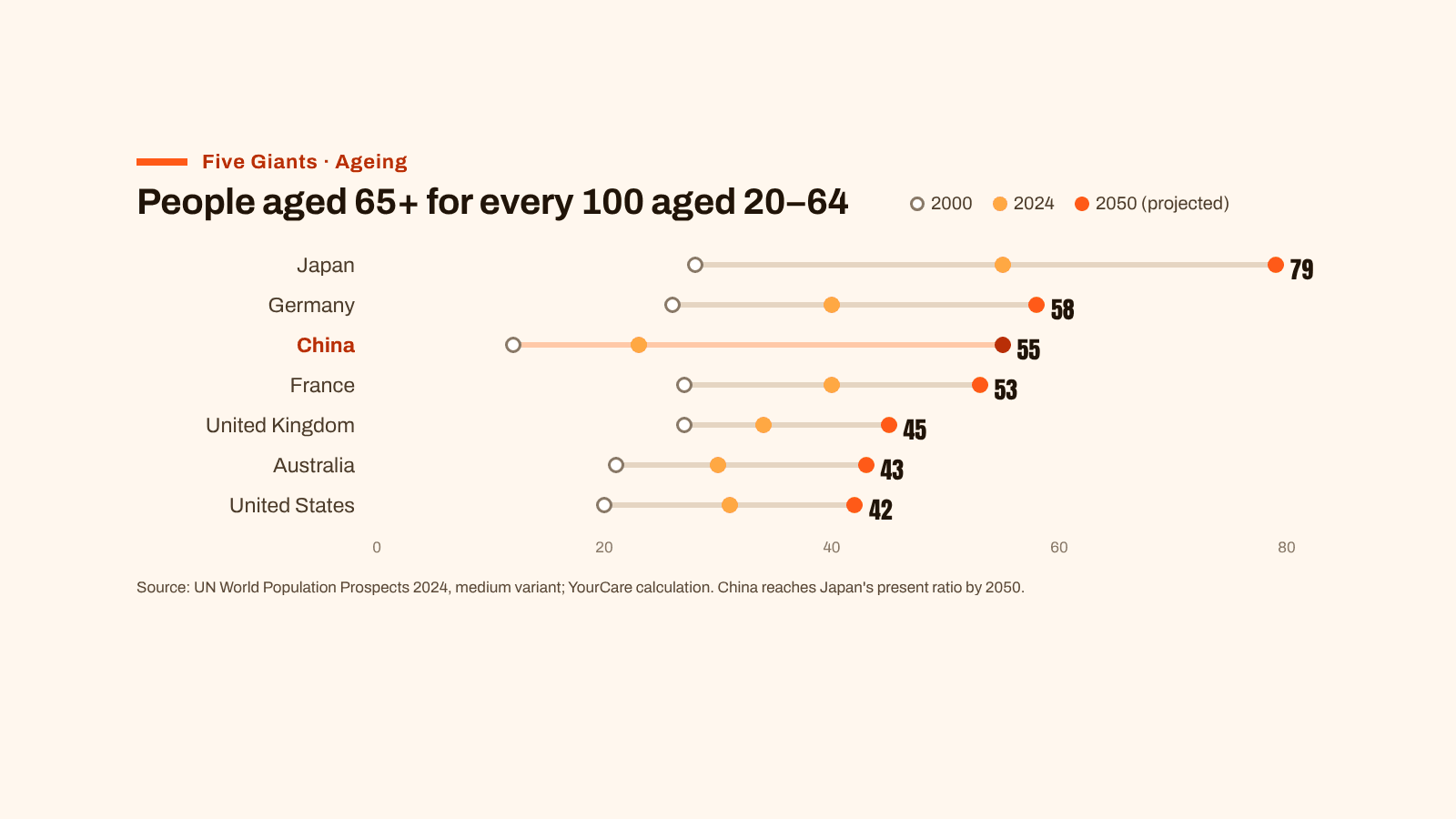
The welfare states of the mid-twentieth century were designed for populations shaped like pyramids: many workers, fewer pensioners, short retirements. That shape has gone. A simple measure is the number of people aged 65 and over for every 100 people of working age, 20 to 64. In 2000 Britain had 27; it now has 34, and the UN projects 45 by 2050. Australia went from 21 to 30 and is heading for 43; the United States from 20 to 31, heading for 42. Germany and France already have about 40 and will pass 50.
Japan, the oldest large country, has 55 and is projected to reach 79. China is the fastest. In 2000 it had 12 older people for every 100 of working age; today it has 23; by 2050 it will have 55, which is roughly where Japan is now. China is getting old in a generation, before it has finished getting rich, and it is trying to build its welfare state while that happens.
The very old matter most for care. The share of the population aged 80 and over roughly doubles in almost every one of these countries by 2050: from about 5 per cent to 9 in Britain, from 4 to 9 in America and Australia, from 2.5 to 10.5 in China. And the extra years are not all healthy ones. In Britain a man can expect to live to 79 but to be in good health only until about 61; for women the figures are 83 and 61. That is roughly two decades, on average, in which health is not good, and much of the cost of those years falls outside the NHS.
The risk nobody pooled
The second pressure is the one the first two essays kept returning to. When the state took over sickness and old age, it mostly left long-term care alone: the years of help with washing, dressing and eating, at home or in a care home. That risk was never pooled at scale before the state arrived, and in most countries it still is not.
Rich countries now spend between about 1.3 and 4 per cent of GDP on long-term care. The European Commission projects public spending on it across the EU rising from 1.7 per cent of GDP in 2022 to 2.6 per cent by 2070; in Denmark it roughly doubles. What matters as much as the total is who pays. In the Netherlands and Denmark, which built public care systems, households pay 5 to 7 per cent of the cost privately. In Britain the figure is 32 per cent, in Germany 29, in America 26 and in France 25. Those are the countries where care was left partly to the means test or to a fixed contribution that covers only part of the bill.
Most care is not counted at all. Across 23 OECD countries about one person in eight over 50 provides unpaid care at least weekly. Carers UK values unpaid care in England and Wales at £162 billion a year, more than the NHS budget for England. And the paid workforce is thin. The OECD average is about five long-term care workers for every 100 people aged 65 and over, and keeping even that ratio would need 13.5 million more care workers across OECD countries by 2040, a rise of 60 per cent. In America the ratio is four. Wages, migration rules and training will decide whether those workers exist. Where they do not, the work falls back on families.
From promises to accounts
The third pressure is quieter. Over forty years, institutions have handed risks back to individuals while keeping the form of a guarantee.
Pensions show it most clearly. A defined-benefit pension promises an income; the fund carries the risk that markets fall or members live longer. A defined-contribution pension promises only what has been saved; the member carries both risks. In America 70 per cent of private-sector workers now have access to a defined-contribution plan and 14 per cent to a defined-benefit one. In Britain active members of private-sector final-salary schemes fell from about two million in 2012 to 662,000 in 2025; three-quarters of those schemes are closed to new saving. Australia's superannuation has been defined-contribution almost from its start in 1992. Each worker now holds their own risk of outliving their money, which is exactly the risk a pool exists to spread.
Care has gone the same way, under a more attractive name. Individual budgets give a person money instead of a service and let them choose. Australia's National Disability Insurance Scheme now has about 775,000 participants and its spending grew 11 per cent in the year to March. In Germany, 56 per cent of people receiving care insurance take only the cash benefit, usually to pay family members, rather than professional care. In England direct payments make up 24 per cent of council spending on community care for working-age adults and 16 per cent for older people. The gains in choice and dignity are real, and so is the change in who decides, which this publication will return to in its own right. What most schemes have not settled is what happens when a budget runs short, a carer falls ill or a plan is cut. For now, the household absorbs it alone.
Thresholds that do not move
The cheapest way to cut a welfare system is to leave its numbers alone while prices rise. England's care means test lets people keep £23,250 before they must pay the full cost; that limit has not changed since 2010–11, and had it kept pace with inflation it would be about £35,000. In most American states a person must have no more than $2,000 in assets to qualify for Medicaid's long-term care. Germany's care insurance pays fixed sums, so as costs rise the resident's share grows: €3,108 a month in 2025, €3,364 by July 2026. Australia began new means-tested contributions for residential care in November 2025. None of these needed a vote to bite harder. Inflation did the work.
The control case and the fast case
America is the control case in this series, the country that never built a universal tier. Its strain shows where the others are heading if nothing changes. Medicaid, a means-tested programme for the poor, pays for 46 per cent of the country's long-term care. You qualify by having spent almost everything first. The 2025 budget law cuts Medicaid and the children's health programme by about $990 billion over ten years, and the Congressional Budget Office expects ten million more people without insurance by 2034.
China is the fast case. Its population over 65 reached 15.9 per cent at the end of 2025, and its population is now falling. The state's answers have come in quick succession. Retirement ages started rising in January 2025, for men from 60 to 63 over fifteen years. Enrolment in residents' health insurance becomes a legal duty in 2027. And in March 2026 the government ordered a national long-term care insurance system, after a decade of pilots that enrolled about 310 million people. China is building in twenty years what Europe built in a century, and it is doing so while ageing faster than Europe ever did.
What the strain has in common
Put the three pressures together and the common response comes into view. Governments everywhere are keeping the promise in name and shifting its cost in practice. Co-payments rise and thresholds freeze. Cash replaces services and accounts replace pensions. Waiting lists stand in for budgets. Each step is defensible on its own. Together they move risk from institutions that can spread it to households that cannot.
There is one instructive exception. Japan built its long-term care insurance in 2000 as a contributory fund that everyone over 40 pays into. Its premiums are reset in public every three years, and the average for over-65s is now ¥6,225 a month, a record. Nobody pretends the cost is not rising. Members can see what the pool costs and what it pays, and the argument about it happens in the open. Germany's care funds, for all their shortfall, have the same visibility: the number is published, and the members know it. In the systems that rely on general taxation and means tests, the same pressure arrives as a freeze nobody announced, a wait nobody chose, and a bill that turns up in the post.
Ageing will continue whatever governments decide. What they can decide is whether the risk it brings is pooled where people can see it, or pushed back onto households one at a time. The next essay looks at what is being tried, from the official reforms now under way to the bolder experiments around their edges, and at why so many of the bolder ones have failed.
Sources: UN World Population Prospects 2024 (old-age dependency and 80+ shares, YourCare calculation from the medium variant); ONS, Health state life expectancies UK 2022–24 and National life tables 2022–24; OECD Health Expenditure and Financing database (long-term care spending 2023); European Commission, 2024 Ageing Report (Institutional Paper 279); OECD Health Working Paper 140 (2022) on informal carers; Carers UK (May 2023); OECD, Who Cares? Attracting and retaining care workers (2020) and long-term care resources dataset; US Bureau of Labor Statistics, Employee Benefits Survey (March 2026); The Pensions Regulator, DB landscape 2025; NDIA quarterly report Q3 2025–26; German Federal Ministry of Health, care insurance benefit recipients 2024; DHSC, Adult social care finance report 2024–25; vdek analysis of nursing-home own contributions (July 2026); Australian Department of Health, aged care fees from 1 November 2025; Congressional Research Service, long-term care financing (August 2025); CBO coverage estimates of the 2025 reconciliation law (August 2025); National Bureau of Statistics of China (January 2026); NPC Standing Committee decision on retirement age (September 2024); State Council guidelines on long-term care insurance (March 2026); Japan Ministry of Health, Labour and Welfare, long-term care insurance premiums 2024–26; Australian Department of Health and Aged Care, Support at Home reporting (October 2026).
Get Early Access
YourCare is preparing for iOS App Store submission. Join the waitlist.
Join the Waitlist